Disclosure: This article may contain affiliate links. If you sign up through them we may earn a commission at no extra cost to you. This never affects our recommendations.
If you are looking for the best ETFs for beginners, you are in the right place. Exchange-traded funds are one of the simplest, lowest-cost ways for new investors to build real wealth without needing to pick individual stocks. In this guide we break down exactly what makes a great beginner ETF, compare the top options side by side, and give you clear steps to get started today.
- The best ETFs for beginners are low-cost, broadly diversified, and easy to buy on any major brokerage.
- A total-market or S&P 500 index ETF (like VTI or VOO) gives you instant exposure to hundreds or thousands of stocks for as little as $1.
- Expense ratios matter enormously over time — even a 0.03% fee versus a 0.50% fee can cost thousands of dollars across a 30-year career.
- Brokerages like Fidelity and Charles Schwab let you buy ETFs with no trading commission and no minimum deposit.
- A simple two- or three-ETF portfolio covers stocks, bonds, and international markets — no complex stock-picking required.
What Are ETFs and Why Are They Perfect for Beginners?
An ETF, or exchange-traded fund, is a basket of securities — stocks, bonds, or other assets — that trades on a stock exchange just like a single share. When you buy one share of a total-market ETF, you instantly own tiny pieces of hundreds or even thousands of companies.
For beginners, this is a game-changer. Instead of gambling on whether Apple or Tesla will go up next month, you own the whole market. If the economy grows over time, your investment grows with it. According to Investor.gov, ETFs are one of the most cost-efficient investment vehicles available to everyday investors.
The best ETFs for beginners share three key traits: a very low expense ratio (annual fee), broad diversification, and high liquidity so you can buy and sell easily anytime the market is open.
Best ETFs for Beginners: Top Picks Compared
Below is a quick comparison of the most recommended beginner ETFs. All figures are approximate and based on publicly available data — always check the fund provider for the latest expense ratio before investing.
| ETF | What It Tracks | Expense Ratio | Best For | Rating |
|---|---|---|---|---|
| VTI – Vanguard Total Stock Market | ~3,600 US stocks | 0.03% | Widest US coverage | ⭐⭐⭐⭐⭐ |
| VOO – Vanguard S&P 500 | 500 largest US companies | 0.03% | Simple S&P 500 exposure | ⭐⭐⭐⭐⭐ |
| SCHB – Schwab US Broad Market | ~2,500 US stocks | 0.03% | Schwab account holders | ⭐⭐⭐⭐⭐ |
| FZROX – Fidelity Zero Total Market | ~2,700 US stocks | 0.00% | Absolute lowest cost (Fidelity only) | ⭐⭐⭐⭐⭐ |
| VXUS – Vanguard Total International | ~7,700 non-US stocks | 0.07% | Global diversification | ⭐⭐⭐⭐ |
| BND – Vanguard Total Bond Market | US investment-grade bonds | 0.03% | Adding stability to a portfolio | ⭐⭐⭐⭐ |
Expense Ratio Comparison (Visual)
Lower is better. Even small differences compound dramatically over decades.
Deep Dive: The Best ETFs for Beginners One by One
1. VTI – Vanguard Total Stock Market ETF
VTI is consistently recommended as one of the best ETFs for beginners because a single purchase instantly diversifies you across the entire US stock market — small, mid, and large companies. Its expense ratio of just 0.03% means you pay only $0.30 per year on a $1,000 investment.
- ✓ Ultra-low 0.03% expense ratio
- ✓ ~3,600 stocks in one fund
- ✓ Available on all major brokerages
- ✓ Decades of track record
- ✗ US-only (no international exposure)
- ✗ Can still drop 30–50% in a crash
- ✗ No bond allocation included
You can buy VTI through Fidelity, Charles Schwab, Robinhood, or Interactive Brokers — all commission-free.
2. VOO – Vanguard S&P 500 ETF
VOO tracks the S&P 500 index, which covers the 500 largest publicly traded US companies. It is one of the most popular ETFs in the world by assets under management. If you’ve ever heard “just buy the index,” this is usually what people mean.
- ✓ Tracks the most-cited US index
- ✓ Extremely liquid and easy to trade
- ✓ 0.03% expense ratio
- ✓ Warren Buffett recommends S&P 500 index funds for most investors
- ✗ Skips small-cap US stocks
- ✗ Heavy concentration in tech (Apple, Microsoft, NVIDIA)
- ✗ No international or bond exposure
3. FZROX – Fidelity ZERO Total Market Index Fund
FZROX has a 0.00% expense ratio — literally zero annual fee. It is only available inside a Fidelity account, but if you’re starting there anyway it is arguably the cheapest way to own the US market. Note that FZROX is a mutual fund that trades like an ETF within Fidelity’s platform.
4. VXUS – Vanguard Total International Stock ETF
VXUS gives you exposure to roughly 7,700 stocks across Europe, Asia, emerging markets, and beyond. Pairing VTI with VXUS is a classic two-fund strategy that covers virtually the entire global stock market at minimal cost.
5. BND – Vanguard Total Bond Market ETF
Bonds tend to fall less sharply than stocks during market downturns, making BND a great stabiliser. Adding even 10–20% BND to a stock ETF portfolio can smooth out the ride, which matters a lot for beginners who might panic-sell during a crash.
How to Build a Simple Beginner ETF Portfolio
You do not need more than two or three ETFs to have a well-diversified portfolio. Here are two simple starting points:
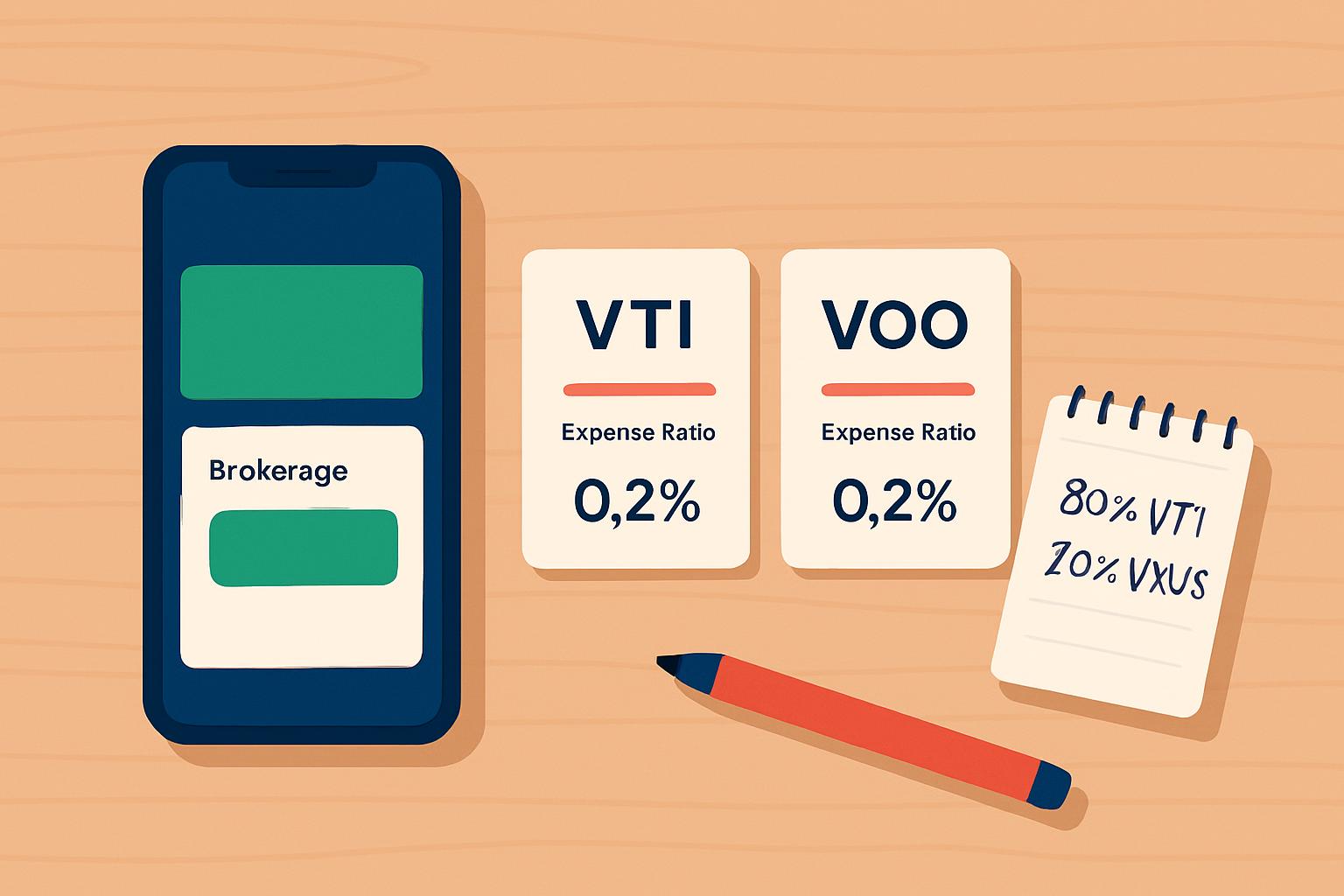
- Two-Fund Portfolio: 80% VTI + 20% VXUS — covers the entire global stock market.
- Three-Fund Portfolio: 60% VTI + 20% VXUS + 20% BND — adds bond stability for more conservative investors.
This approach is recommended by the Vanguard investment philosophy and countless fee-only financial advisors. Keep it simple, keep costs low, and invest consistently over time.
For more on building a starter portfolio, check out our guide on how to invest in ETFs and our roundup of the best index funds for beginners.
Where to Buy the Best ETFs for Beginners
Choosing the right brokerage is just as important as choosing the right ETF. Here are four beginner-friendly platforms:
- Fidelity — No account minimum, no trading commissions, fractional shares available, and access to the zero-fee FZROX fund. Excellent for beginners.
- Charles Schwab — No minimum deposit, commission-free ETF trades, and a beginner-friendly interface. Also offers fractional shares through “Stock Slices.”
- Robinhood — Simple mobile-first app, $1 fractional share investing, no commissions. A popular entry point for first-time investors.
- Interactive Brokers — Very low costs, ideal if you plan to invest larger amounts or want access to international markets as you grow.
Common Mistakes Beginners Make With ETFs
Even with the best ETFs for beginners, there are a few traps that can hurt your returns:
- Chasing last year’s winners. An ETF that returned 40% last year often reverts to average (or worse) the next year. Stick to broadly diversified funds.
- Ignoring the expense ratio. A fund charging 0.70% per year instead of 0.03% costs you roughly $1,300 more per $1,000 invested over 30 years (assuming 7% annual growth before fees). That is real money.
- Panic-selling in downturns. Markets drop. The S&P 500 has recovered from every single crash in its history. Selling during a dip locks in losses permanently.
- Buying too many ETFs. Ten ETFs that all track the US market is not diversification — it is redundancy. Two or three well-chosen funds are enough.
What to Do Next: Your Step-by-Step Action Plan
- Open a brokerage account — Choose Fidelity or Schwab if you want the most beginner-friendly experience with no minimum deposit.
- Decide on your split — Start simple: 80% VTI and 20% VXUS covers the whole world. Add BND if you want lower volatility.
- Set up automatic contributions — Even $25 or $50 per month builds serious wealth over 20–30 years thanks to compound growth.
- Reinvest dividends automatically — Both Fidelity and Schwab let you turn on DRIP (dividend reinvestment) so every dollar works harder.
- Review once a year — Rebalance if your allocation drifts more than 5% from your target. Otherwise, leave it alone.
Frequently Asked Questions
What is the best ETF for an absolute beginner?
VTI (Vanguard Total Stock Market ETF) or VOO (Vanguard S&P 500 ETF) are the two most commonly recommended starting points. Both have a 0.03% expense ratio and give you instant exposure to hundreds of US companies. If you use Fidelity, FZROX offers the same coverage at 0.00% cost.
How much money do I need to start investing in ETFs?
You can start with as little as $1 using fractional shares on Fidelity, Charles Schwab, or Robinhood. There is no minimum deposit required to open an account at these brokerages. Even $25 per month invested consistently can grow significantly over time.
Are the best ETFs for beginners the same as index funds?
Almost. Index funds and ETFs both track a market index passively. The main difference is that ETFs trade throughout the day on an exchange (like a stock), while traditional index mutual funds only price once at day’s end. For most beginners, the practical difference is small — both are excellent, low-cost choices.
How many ETFs should a beginner hold?
Two to three is ideal. A total US market ETF (VTI), a total international ETF (VXUS), and optionally a bond ETF (BND) gives you near-complete global diversification. Holding more ETFs rarely improves diversification and adds unnecessary complexity.
Is it safe to put all my savings into one ETF?
A single broad-market ETF like VTI is far safer than buying individual stocks, because you own a slice of thousands of companies. However, all ETFs carry market risk — their value can fall significantly in a recession. Only invest money you will not need for at least five years, and keep an emergency fund in cash or a high-yield savings account.
Do ETFs pay dividends?
Yes. Most stock ETFs, including VTI and VOO, pay quarterly dividends. You can have these automatically reinvested (called DRIP) so they buy additional shares, compounding your growth over time. Your brokerage handles this automatically if you opt in.
Final Thoughts on the Best ETFs for Beginners
The best ETFs for beginners are not complicated or exotic. They are simple, low-cost, broadly diversified funds that let the market do the heavy lifting. VTI and VOO are the bedrock of millions of successful long-term portfolios. FZROX makes zero-fee investing a reality inside Fidelity. VXUS and BND add global reach and stability to round out a complete portfolio.
The most important thing is to start. Open an account at Fidelity or Charles Schwab, pick one or two of the ETFs above, set up a recurring contribution, and let compound growth work in your favour over the years ahead.
Start Investing in ETFs Today →This article is for educational purposes only and does not constitute financial or investment advice. Fund names, tickers and fees are examples only, not recommendations — confirm current expense ratios and details on each provider’s official site and do your own research before investing. Investing involves risk, including the possible loss of your capital.
- VOO vs SPY — the two largest S&P 500 ETFs on cost and liquidity.
- SCHD vs VYM — the two most popular dividend ETFs compared.

Izhaq Shah is the founder of GetIntoMarkets. He holds a Master’s in Finance and Commerce, with over 10 years in the financial industry and 15 years of writing experience. He makes investing in stocks, ETFs and crypto simple and practical for everyday people building wealth with confidence.