Disclosure: This article may contain affiliate links. If you sign up through them we may earn a commission at no extra cost to you. This never affects our recommendations.
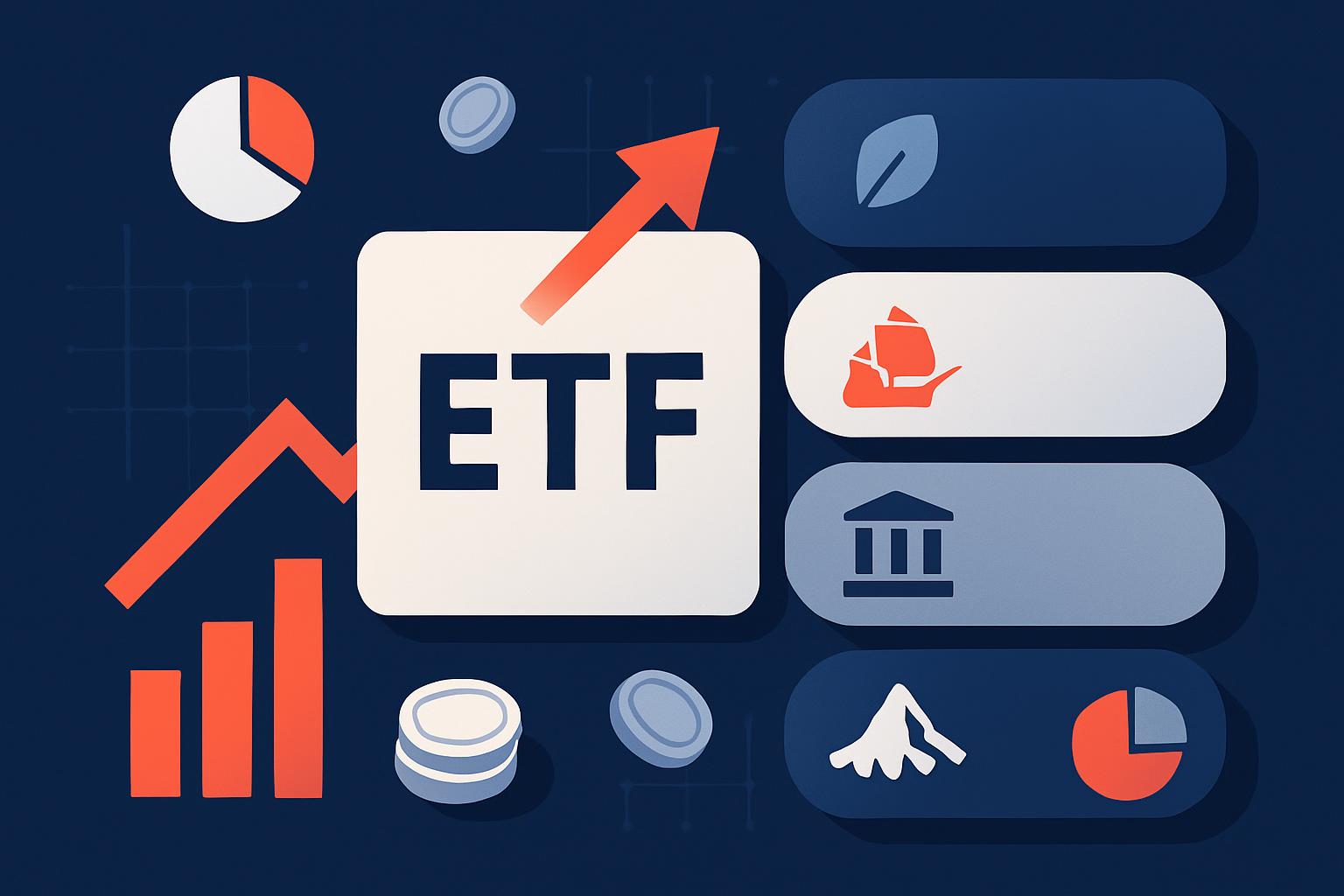
If you have ever wondered what is an ETF and whether it belongs in your portfolio, you are in the right place. An ETF — short for Exchange-Traded Fund — is one of the most beginner-friendly investment tools available today. In plain English, it lets you buy a basket of assets in a single trade, at low cost, through any standard brokerage account. This guide walks you through everything: how ETFs work, the types available, what they cost, and exactly how to buy your first one.
- An ETF (Exchange-Traded Fund) is a single investment that holds many assets — stocks, bonds, or commodities — inside one tradeable package.
- ETFs trade on stock exchanges in real time, just like individual shares, making them highly flexible.
- Most passive ETFs carry very low costs — expense ratios typically start below 0.10% for broad index products.
- You can start investing in ETFs with as little as $1 using fractional shares at brokers such as Fidelity and Charles Schwab.
- ETFs carry market risk — their value can fall — but diversification across many holdings reduces the impact of any single company collapsing.
What Is an ETF? The Simple Definition
Breaking Down the Name: Exchange-Traded Fund
The name tells you almost everything. Exchange-Traded means the fund is bought and sold on a stock exchange — just like a share of Apple or Tesla. Fund means it pools money to hold a collection of assets rather than just one. Put those two ideas together and you have what is an ETF: a fund you can trade at any moment during market hours.
The One-Sentence Explanation a Beginner Needs
An ETF is a single investment product that holds a basket of assets — such as the shares of 500 different companies — so that buying one ETF instantly gives you exposure to all of them.
A Quick Real-World Analogy to Make It Click
Think of a supermarket multipack of juice. Instead of buying twelve individual bottles, you buy one pack that already contains all twelve. An ETF works the same way: instead of buying shares in 500 separate companies, you buy one ETF that already contains all 500. One purchase, instant variety.
ETFs can hold stocks, bonds, commodities such as gold, or even crypto assets. The first US ETF — the SPDR S&P 500 ETF (SPY), managed by State Street Global Advisors — launched in January 1993 (exact date subject to verification) and is still the largest ETF in the world by assets under management.
How Do ETFs Actually Work?
How ETFs Are Created and Redeemed
Behind the scenes, large financial institutions called Authorised Participants — typically big banks or broker-dealers — create new ETF shares by delivering the underlying assets to the fund provider. When demand falls, they can redeem shares in exchange for those underlying assets. This creation and redemption mechanism keeps the ETF’s price closely aligned with the value of what it holds.
How ETF Prices Move During the Day
Unlike mutual funds — which are priced once per day after the market closes — an ETF price updates every second while the exchange is open. You can buy at 10 a.m. and sell at 2 p.m. if you choose. This intraday pricing gives you far more control over your entry and exit points.
Understanding NAV (Net Asset Value) vs Market Price
The Net Asset Value (NAV) is the theoretical value of all the assets held inside the ETF divided by the number of shares outstanding. In practice, the market price you pay can be fractionally above (a premium) or below (a discount) NAV. For large, liquid ETFs like Invesco QQQ or SPY, the gap is typically tiny — often just a few cents. Also be aware of the bid-ask spread: the small difference between the buying price and the selling price, which acts as a minor transaction cost.
Types of ETFs You Should Know About
Stock ETFs: Owning a Slice of the Market
Equity ETFs hold shares in companies and are the most common type. The SPDR S&P 500 ETF (SPY) tracks the S&P 500 Index of America’s 500 largest companies. The Invesco QQQ tracks the NASDAQ-100, home to the biggest technology names. Both are excellent starting points for a beginner’s portfolio.
Bond and Fixed-Income ETFs
Bond ETFs hold government or corporate debt. TLT (iShares 20+ Year Treasury Bond ETF), managed by BlackRock iShares, gives exposure to long-term US government bonds. Bond ETFs tend to be less volatile than stock ETFs and can balance a portfolio during stock market downturns.
Commodity, Crypto, and Thematic ETFs
Commodity ETFs track physical goods. GLD (SPDR Gold Shares) is a well-known example for gold exposure. Thematic ETFs focus on specific trends such as artificial intelligence or clean energy. BITO (ProShares Bitcoin Strategy ETF) was among the first US-listed crypto ETFs, giving investors Bitcoin price exposure without directly holding cryptocurrency — as of the latest available information, verify currency before investing.
A quick word of caution: leveraged ETFs (e.g., TQQQ, which targets 3× daily Nasdaq returns) and inverse ETFs (e.g., SH, which profits when the S&P 500 falls) are designed for short-term trading by experienced investors. They are not appropriate for most beginners and carry significant risk of permanent capital loss if held long-term. Always read the product documentation before considering these products.
Common Types of ETFs at a Glance
| ETF Type | What It Holds | Beginner Friendly? | Example |
|---|---|---|---|
| Stock / Equity ETF | Shares of many companies | Yes | SPY (S&P 500) |
| Bond ETF | Government or corporate bonds | Yes | TLT (US Treasury Bonds) |
| Sector ETF | Stocks in one industry | Moderate | XLF (Financials) |
| Commodity ETF | Gold, oil, agriculture, etc. | Moderate | GLD (Gold) |
| Crypto ETF | Bitcoin or crypto assets | Caution advised | BITO (Bitcoin Strategy) |
| Leveraged ETF | Amplified market returns | No — high risk | TQQQ (3× Nasdaq) |
| Inverse ETF | Profits when market falls | No — high risk | SH (Short S&P 500) |
ETF vs Mutual Fund: What Is the Difference?
Key Similarities Between ETFs and Mutual Funds
Both ETFs and mutual funds pool investor money to buy a diversified collection of assets. Both are regulated investment vehicles, and both can track an index or be actively managed. The differences, however, matter a great deal for day-to-day investors.
Where ETFs Have the Edge for Beginners
ETFs generally offer lower expense ratios, intraday trading flexibility, and better tax efficiency. The in-kind redemption mechanism — where Authorised Participants swap ETF shares for the underlying securities rather than triggering a cash sale — means the fund rarely has to distribute capital gains to shareholders, reducing your annual tax bill.
When a Mutual Fund Might Still Make Sense
Vanguard index mutual funds, for example, carry expense ratios that compete directly with ETFs. If your workplace pension or 401(k) only offers mutual funds, they remain a solid choice. Mutual funds also allow you to invest an exact dollar amount rather than a whole share price, which can suit automated monthly contributions.
| Feature | ETF | Mutual Fund |
|---|---|---|
| Trading Hours | Intraday on stock exchange | Once per day after market close |
| Minimum Investment | Price of 1 share (or $1 with fractional) | Often $500–$3,000+ |
| Typical Expense Ratio | 0.03%–0.75% (passive to active) | 0.5%–1.5%+ (verify current averages) |
| Tax Efficiency | Generally higher (in-kind redemption) | Generally lower |
| Price Transparency | Real-time | End-of-day NAV only |
| Management Style | Mostly passive (some active) | Both passive and active |
For a deeper look, read our guide on ETF vs index fund: what is the difference.
What Are the Costs of Investing in ETFs?
The Expense Ratio Explained
The expense ratio is the annual fee the fund charges, expressed as a percentage of your investment. It is deducted automatically — you never write a cheque. Broad index ETFs from providers like BlackRock iShares and Vanguard often carry expense ratios well below 0.10%. Actively managed ETFs can run to 0.50%–0.75% or more. To understand exactly how this cost is calculated, see our dedicated article on what is an expense ratio.
Trading Commissions and Bid-Ask Spreads
Most major brokers — including Fidelity, Charles Schwab, and eToro — now offer commission-free ETF trading. You still pay the bid-ask spread, which for liquid ETFs like SPY is usually less than $0.01 per share.
Hidden Costs Beginners Often Overlook
Tracking error is the small gap between an ETF’s actual return and the index it follows — usually caused by fees, trading costs, and cash drag. For internationally focused ETFs, currency risk adds another layer: if the US dollar strengthens against the euro, a European ETF may return less in dollar terms even if European stocks rose.
Expense Ratio Comparison: ETF vs Mutual Fund
Passive ETF (~0.16%)
Passive Mutual Fund (~0.44%)
Active ETF (~0.63%)
Active Mutual Fund (~0.66%)
Indicative figures only — verify against ICI 2024 Fact Book before making decisions. Bars scaled to 100% = 1.00%.
Benefits and Risks of ETF Investing
Top Reasons Beginners Love ETFs
- ✓ Instant diversification across dozens or hundreds of assets
- ✓ Low cost — expense ratios far below most active funds
- ✓ High liquidity — buy or sell any time the market is open
- ✓ Transparent — full holdings published daily
- ✓ Accessible — start with as little as $1 via fractional shares
- ✗ Market risk — if the index falls, your ETF falls too
- ✗ Niche ETFs can have low volume and wide bid-ask spreads
- ✗ Synthetic ETFs carry counterparty risk from derivatives
- ✗ No FDIC insurance — you can lose money
- ✗ Diversification reduces but does not eliminate risk
Is an ETF Safe? Setting Realistic Expectations
ETFs are regulated investment products. In the US, they are overseen by the SEC (U.S. Securities and Exchange Commission); in the UK by the FCA (Financial Conduct Authority); and in the EU by ESMA — verify which regulator applies to your country. Regulation provides important protections around disclosure and fund structure, but it does not protect against losses. An ETF tracking the S&P 500 will fall when the S&P 500 falls. That is normal and expected over shorter timeframes. For an authoritative overview of investment risks, see the SEC’s investor education page on ETFs.
How to Buy Your First ETF: Step-by-Step
Step 1 — Choose a Brokerage Account
You need a brokerage account to buy what is an ETF. Below are four beginner-friendly options (presented as examples only — not endorsements):
| Broker | Best For | ETF Commission | Fractional Shares? |
|---|---|---|---|
| Fidelity | All-round beginners | $0 | Yes (from $1) |
| Charles Schwab | Research & tools | $0 | Yes (from $5) |
| eToro | Social & international | $0 (spread applies) | Yes |
| Interactive Brokers | Global ETF access | $0 on IBKR Lite | Yes |
To get started, read our full walkthrough on how to open a brokerage account.
Open a Free Account →Step 2 — Research and Select an ETF
Before you buy, check four things: the expense ratio, the underlying index it tracks, the assets under management (AUM) — larger funds tend to be more liquid — and the average daily trading volume. You can find all of this on the fund’s fact sheet or KIID (Key Investor Information Document). Our guide to the best ETFs for beginners shortlists the most popular options with these metrics compared.
Step 3 — Place Your Order and Monitor Your Investment
A market order buys at the current best available price immediately. A limit order lets you set the maximum price you are willing to pay — the order only executes if the ETF reaches that price. For most beginners, a market order during normal trading hours works perfectly well. Once invested, consider automating monthly contributions — a strategy known as dollar-cost averaging — to reduce the impact of short-term market swings.
What To Do Next
- Open a brokerage account at Fidelity or Charles Schwab (both free, no minimum balance required).
- Choose a broad index ETF such as SPY or a low-cost equivalent as your starting point.
- Place a limit order for the amount you want to invest — start small if you are uncertain.
- Set up a monthly automatic investment using dollar-cost averaging.
- Review your holdings quarterly — do not check daily, as short-term price swings are normal.
Frequently Asked Questions About ETFs
Can I lose all my money in an ETF?
Losing everything in a broad index ETF is extremely unlikely because your money is spread across hundreds of companies. For a single company to destroy your investment, every company in the index would need to go to zero simultaneously. That said, all investments carry risk and ETF values do fall during market downturns. Niche or single-sector ETFs carry higher concentration risk. Always invest only what you can afford to keep invested for several years.
How much money do I need to start investing in ETFs?
As little as $1 if your broker offers fractional shares — both Fidelity and Charles Schwab offer fractional ETF investing as of the latest available information (verify current availability before opening an account). Without fractional shares, the minimum is the price of one full ETF share.
Are ETFs good for beginners?
Yes — understanding what is an ETF is often the first step to building a long-term portfolio. ETFs offer instant diversification, low fees, real-time trading, and no requirement for stock-picking expertise. A simple two-ETF portfolio — one global equity ETF and one bond ETF — can give a beginner a well-balanced, low-cost investment strategy from day one.
What is the difference between an ETF and an index fund?
The terms overlap significantly. An index fund is any fund that tracks an index — it can be structured as either an ETF or a mutual fund. The key practical difference is that ETF index funds trade in real time on an exchange, while index mutual funds are priced once daily. Both are excellent for passive, low-cost investing. See our full breakdown: ETF vs index fund: what is the difference.
Do ETFs pay dividends?
Many do. When the companies inside an equity ETF pay dividends, the ETF collects them and passes them to shareholders. Distributing ETFs pay this income out as cash to your brokerage account — usually quarterly. Accumulating ETFs automatically reinvest dividends back into the fund, compounding your returns without any action from you. Check the fund’s fact sheet to see which type you are buying.
How are ETFs taxed?
ETF taxation varies significantly by country and individual circumstances. In the US, you typically pay capital gains tax when you sell shares for a profit, and income tax on dividends received. In the UK, ETFs held inside an ISA are sheltered from both taxes. This article does not constitute tax advice. Please consult a qualified tax adviser for guidance specific to your situation. For crypto ETFs specifically, tax rules can be even more complex — see our guide on what is a crypto ETF.
What is a crypto ETF and is it safe?
A crypto ETF gives investors exposure to cryptocurrency prices through a regulated exchange-listed product, without requiring them to hold digital assets directly. BITO (ProShares Bitcoin Strategy ETF) was an early example, using Bitcoin futures contracts. Spot Bitcoin ETFs have since gained regulatory approval in the US (verify current status at time of reading). Crypto ETFs are significantly more volatile than broad stock ETFs and are best approached with caution. Read our dedicated explainer: what is a crypto ETF.
Now that you know what is an ETF and how it works, the next step is putting that knowledge into action. Explore our curated picks and step-by-step guides below.
Best ETFs for Beginners → How to Open a Brokerage Account →This article is for informational and educational purposes only and does not constitute financial, investment, or tax advice. All investments carry risk, including the possible loss of capital. Past performance is not a reliable indicator of future results. Please consult a qualified financial adviser before making investment decisions.
Related guides
- How to Invest in ETFs for Beginners
- How to Invest in Gold ETFs
- What Are ETFs and Why They’re Perfect for Beginners
- What Is a Stock? A Beginner’s Guide
- How to Buy Your First Stock
You might also like: Are ETFs Better Than Individual Stocks for Beginners?
More on ETFs: ETFs vs Mutual Funds and What Is an Index Fund?

Izhaq Shah is the founder of GetIntoMarkets. He holds a Master’s in Finance and Commerce, with over 10 years in the financial industry and 15 years of writing experience. He makes investing in stocks, ETFs and crypto simple and practical for everyday people building wealth with confidence.