
If you have ever worried about buying at the wrong time, dollar-cost averaging (DCA) is the beginner-friendly strategy that takes the guesswork out of investing. Instead of trying to time the market, you invest a fixed amount on a regular schedule — and let consistency do the heavy lifting.
What Is Dollar-Cost Averaging?
Dollar-cost averaging means investing the same fixed amount of money at regular intervals (say, $100 every month) into the same investment — regardless of whether prices are up or down. When prices are low, your $100 buys more shares; when prices are high, it buys fewer. Over time, this smooths out your average purchase price.
A Simple Example
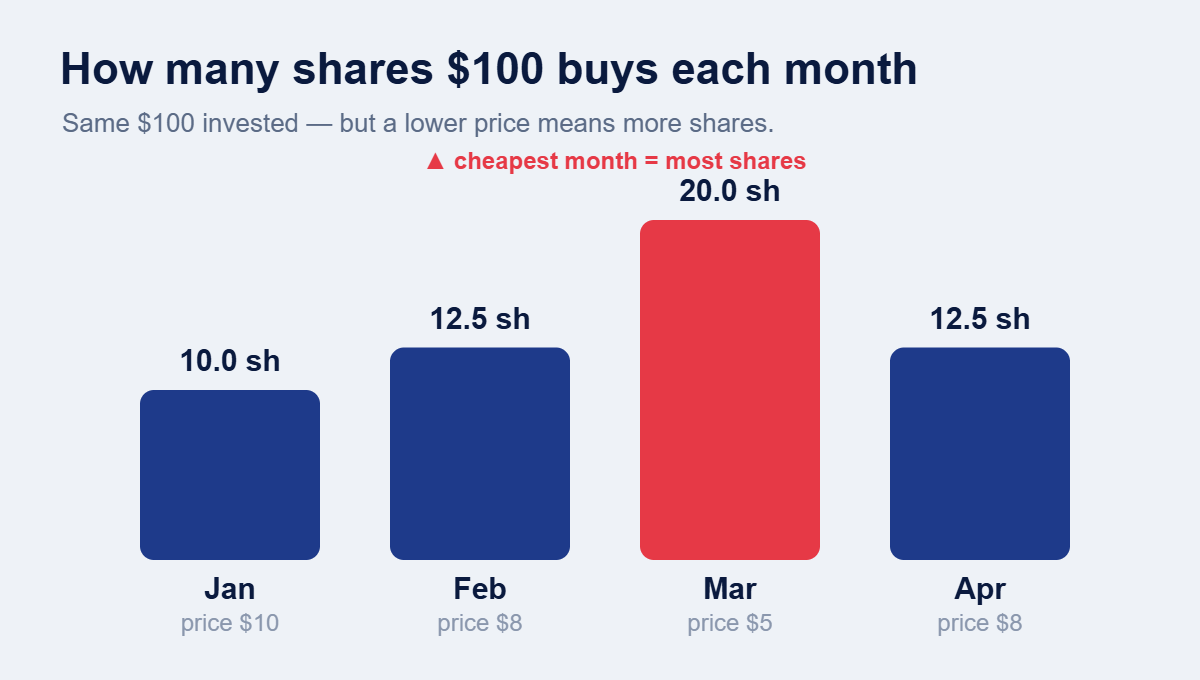
Imagine you invest $100 every month for four months while the share price bounces around:
| Month | Amount Invested | Share Price | Shares Bought |
|---|---|---|---|
| January | $100 | $10 | 10.0 |
| February | $100 | $8 | 12.5 |
| March | $100 | $5 | 20.0 |
| April | $100 | $8 | 12.5 |
| Total | $400 | — | 55.0 |
You invested $400 and own 55 shares — an average cost of about $7.27 per share. Notice that is lower than the simple average price of $7.75, because your fixed $100 automatically bought more shares when the price dropped. That is the quiet magic of DCA.
Why Beginners Love It
- No market timing needed. You never have to guess the “perfect” moment to buy.
- It builds a habit. Automating a fixed monthly amount turns investing into a routine, not a decision.
- It reduces emotion. You keep buying through dips instead of panicking — which is often when the best bargains appear.
- It works with small amounts. You can start with as little as $25–$100 a month.
The Trade-Offs
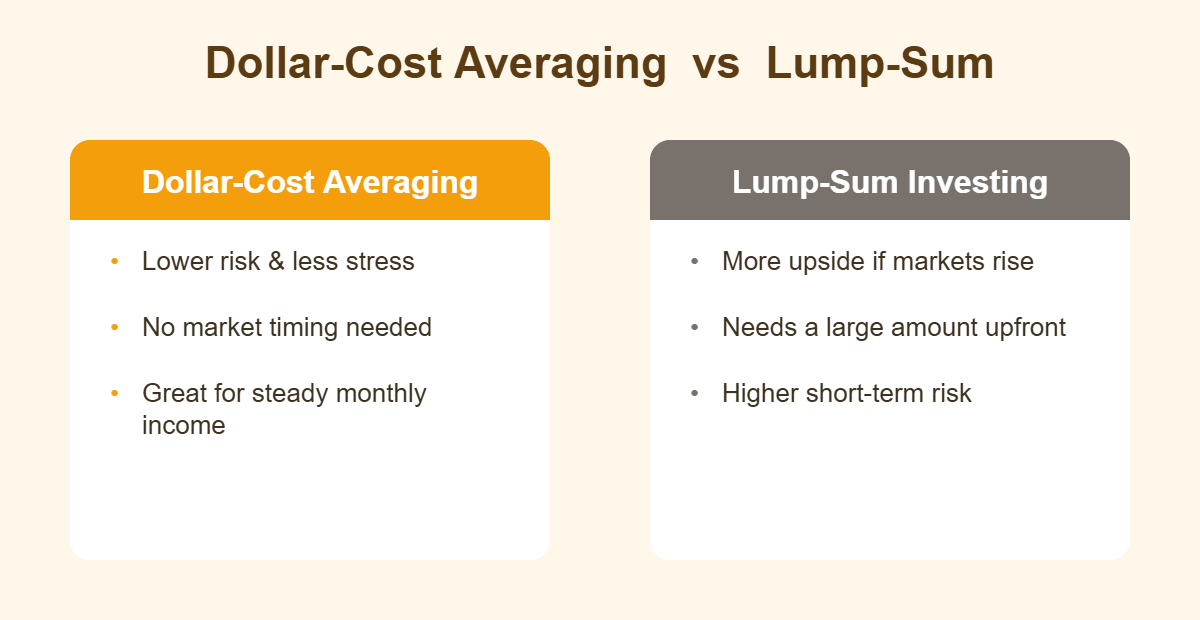
- If markets rise steadily, investing a lump sum earlier would have earned more — DCA trades some upside for lower risk and peace of mind.
- It does not remove risk entirely; the underlying investment still needs to be sound (which is why beginners often pair DCA with a broad index ETF).
How to Start Dollar-Cost Averaging
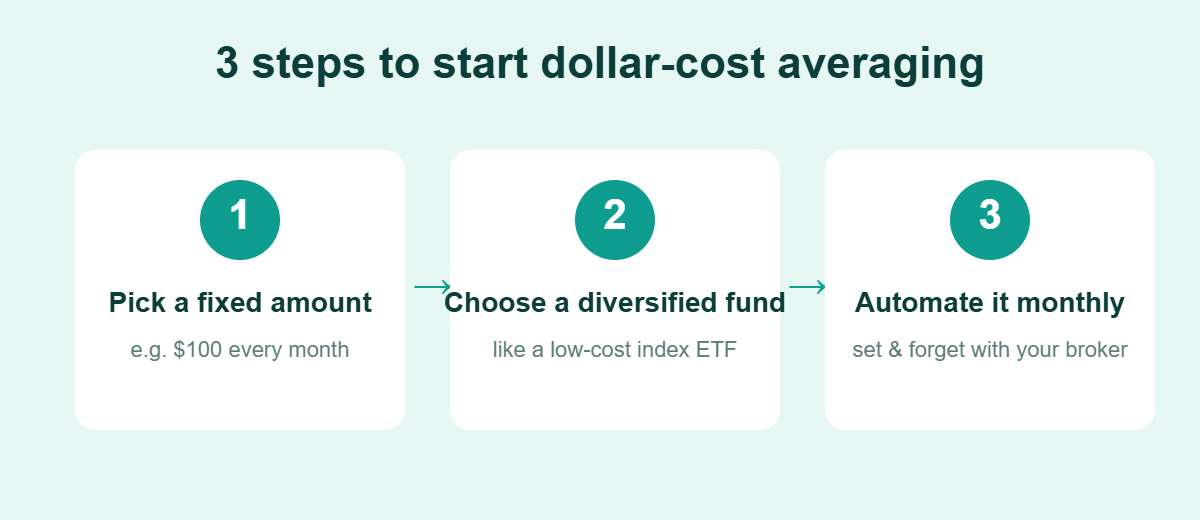
Pick an amount you can comfortably invest every month, choose a diversified investment such as a low-cost index fund, and set up an automatic recurring purchase with your broker so it happens without you thinking about it.
Want to see how those steady monthly contributions could grow? Try our free SIP / recurring investment calculator or explore all our free investing tools. New here? Start with our investing basics guides.
This article is for educational purposes only and is not financial advice. Investing involves risk, including the possible loss of principal. Always do your own research or consult a licensed financial adviser before investing.
- How Much Should I Contribute to My 401k in 2026? — the most common place beginners automate contributions.
- What Is a 401k Match? — how employer matching works alongside regular contributions.

Izhaq Shah is the founder of GetIntoMarkets. He holds a Master’s in Finance and Commerce, with over 10 years in the financial industry and 15 years of writing experience. He makes investing in stocks, ETFs and crypto simple and practical for everyday people building wealth with confidence.